A place where economics, financial markets, and real estate intersect.
Showing posts with label James Bullard. Show all posts

Friday, May 11, 2018

Morning Report: James Bullard thinks no more hikes are warranted

Vital Statistics:

Last Change
S&P futures 2722 3.75
Eurostoxx index 392.17 0.2
Oil (WTI) 71.3 -0.06
10 Year Government Bond Yield 2.96%
30 Year fixed rate mortgage 4.56%

Stocks are higher this morning on no real news. Bonds and MBS are flat. 

Import prices rose 0.3% MOM and 3.3% YOY, driven by oil. Ex-energy import prices were flat. 

St. Louis Federal Reserve Head James Bullard said that interest rates may already be at the level where they are no longer stimulating the economy. There are “reasons for caution in raising the policy rate further given current macroeconomic conditions” he said in his prepared remarks. Bullard has generally been considered a dove, so this is not much of a surprise. He is also a non-voter. He believes that there is little in the inflationary pressures being signaled in the market. 

With respect to inflation signalling, he has a point. The spread between the 30 year bond and the 5 year bond is now the narrowest since 2007. Note that the yield curve generally flattens during tightening phases and is probably not signifying the type of deflationary period that 2007 did. Given all of the QE over the past decade, the signals from the bond markets are heavily distorted and should be taken with a grain of salt. Note short Treasuries is one of the biggest hedge fund trades on the Street. 


Are the homebuilders set to outperform going forward? They have suffered more than the market during the recent declines, but the environment should be favorable for the sector going forward. With a shortage of housing, high demand and rising prices, the sector should be in good shape. The problem for investors? The sector is highly cyclical, and the stock behavior reflects that. In other words, earnings will rise and fall, and the multiple will expand and contract, dampening the effect. So, if the average multiple is typically mid-teens, don't be surprised if P/E ratios fall to the high single digits during boom times. 


Sen Pat Toomey says that the Trump Administration doesn't have the authority to pull out of NAFTA, since it was passed by Congress. On the other hand, the Admin does have the authority to pull out of the Iran Deal, as well as the Paris Accords because they were only deals with the Obama Administration and not the US - never ratified by Congress. 

Friday, May 19, 2017

Morning Report: Treasury and FHFA disagree on the GSEs

Vital Statistics:

Last Change
S&P Futures  2370.5 6.8
Eurostoxx Index 390.7 1.5
Oil (WTI) 50.0 0.6
US dollar index 88.8 -0.4
10 Year Govt Bond Yield 2.24%
Current Coupon Fannie Mae TBA 103.27
Current Coupon Ginnie Mae TBA 104.21
30 Year Fixed Rate Mortgage 4.03

Stocks are up this morning on no real news. Bonds and MBS are down small. 

Slow news day.

No economic data this morning, but we have Fed-speak at 9:45 and 1:40. 

Treasury Secretary Steve Mnuchin and FHFA Head Mel Watt disagree on what to do with Fannie Mae's dividends to Treasury. A week ago, Watt suggested that Fannie and Freddie may have to retain some of their earnings in order to build / maintain their capital base. Yesterday, Mnuchin said that he expected the dividend payments to continue. Despite a Republican president, Mel Watt is going nowhere - his term expires in 2019 and he can only be removed for cause. 

Ellie Mae's Origination Insight Report is out, and it shows that fallout increased, along with the purchase share of mortgages. Cycle times improved by a day across the board. 

St. Louis Fed Head James Bullard believes that the unemployment rate could fall further without igniting inflation. He seems to think the new normal is about 2% GDP growth and sees that sort of pace for the immediate future. That will probably be the case until wage inflation picks up, and who knows when that will be? 

Guess who's back? Ex-NJ governor, MF global collapse Jon Corzine, who is apparently fundraising for a new hedge fund...

Monday, May 8, 2017

Morning Report: Globalism wins in France

Vital Statistics:

Last Change
S&P Futures  2395.0 -2.8
Eurostoxx Index 393.7 -0.9
Oil (WTI) 46.2 0.0
US dollar index 89.9
10 Year Govt Bond Yield 2.37%
Current Coupon Fannie Mae TBA 102.6
Current Coupon Ginnie Mae TBA 103.81
30 Year Fixed Rate Mortgage 4.05

Stocks are lower after Emmanuel Macron won the French election. Bonds and MBS are flat.

The election in France is perceived as a rejection of Trumpism (or whatever you want to call it). It was a return to the globalist left. Seems to be a little "buy the rumor, sell the fact" going on in the markets. 

James Bullard is saying that the Fed Funds rate is close to where the Taylor Rule calculation would recommend they be set. The economy is in a low growth regime, but the labor force is in a high growth regime. As long as the labor market is still taking up slack, we won't see much in the way of wage growth, which should keep the Fed from having to normalize too quickly. Depending on how you set some of the variables, the correct Fed Funds rate is anywhere from 67 basis points to 155 basis points. 

The week after the jobs report is generally pretty data-light so we shouldn't have that much in the way of market-moving data. The biggest chance of market-moving data is Friday when we get retail sales and the consumer price index. We do have Fed-speak every day except for Thursday. 

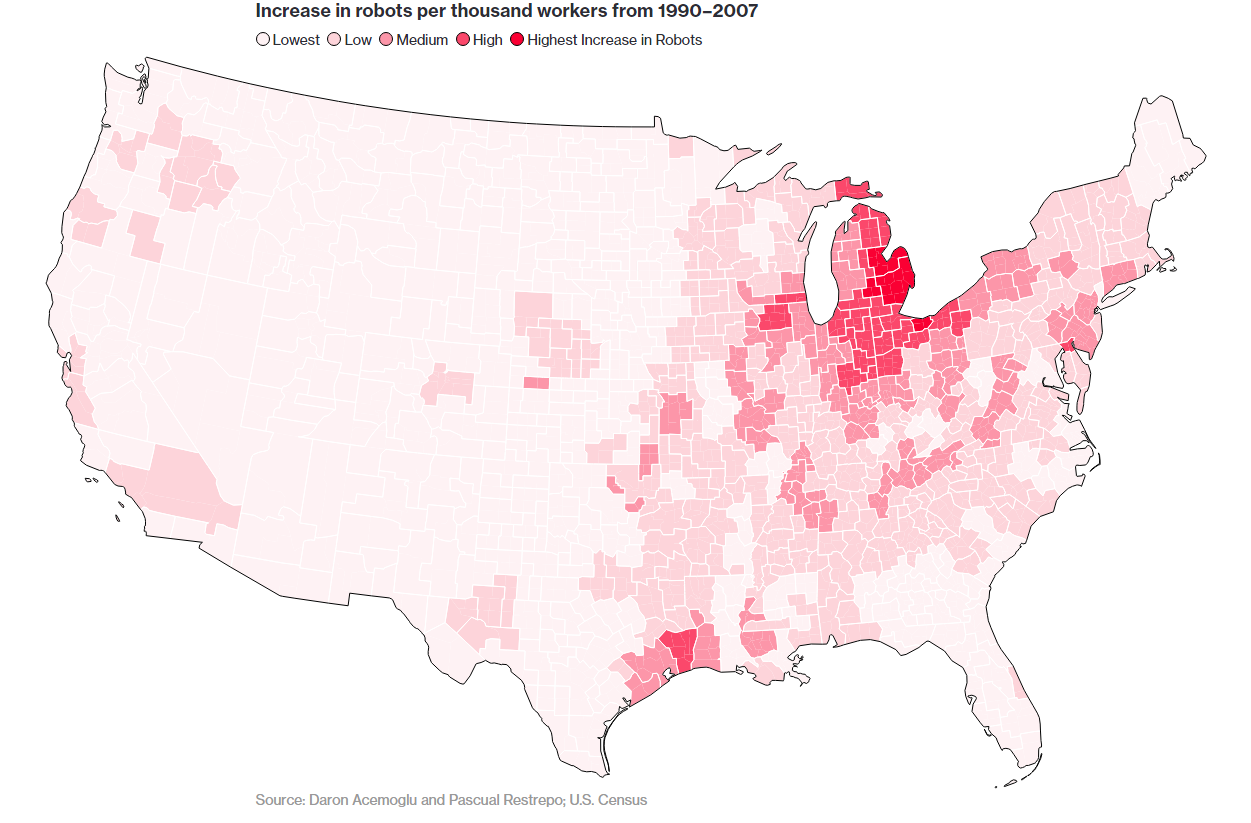
Where are robots more likely to replace workers? It turns out that the upper Midwest is ground zero, however parts of the Northeast are as well. Out West, we see very little of it. This could partially explain why the real estate markets out West are red-hot, while markets in the Rust belt and the Northeast are tepid at best. Automation means jobs are being lost, which results in a declining population. For decades now, the general trend of population growth has been similar to what you would see if you picked up the United States by Maine, dangled it and shook it. Of course robots are a symptom of a bigger problem - some of these industries have high cost structures, and they will either automate or go out of business. Note that the West may not be immune - the next shoe to drop will be artificial intelligence and machine learning which will replace a lot of white collar workers as it develops.


Compare this to the CoreLogic real estate heat map:

Definitely seems to be a correlation between overvalued (red) and undervalued (green) real estate markets and the presence of automation. It makes sense. If people are leaving the green areas, you would expect to have a harder time selling a home (or easier time buying) than in places that are experiencing an increase in population. 

Buffetapalooza or Capitalist Woodstock (the Berkshire Hathaway shareholders' meeting) was over the weekend in Omaha, where you can sing with the Fruit of the Loom guys, eat at Warren's favorite steak house, eat Sees candy, etc. He did have a few words about Wells's scandal (BRK is WFC's biggest shareholder). 


Thursday, January 12, 2017

Morning Report: Market reassessing the post-Trump risk-on trade

Vital Statistics:

Last Change
S&P Futures  2264.8 -6.0
Eurostoxx Index 364.0 -0.9
Oil (WTI) 53.3 1.1
US dollar index 91.8 -0.6
10 Year Govt Bond Yield 2.33%
Current Coupon Fannie Mae TBA 103
Current Coupon Ginnie Mae TBA 104
30 Year Fixed Rate Mortgage 4.1

Markets are lower after Trump's press conference yesterday. Bonds and MBS are up

We saw stocks sell off (and bond rally) after Donald Trump's press conference yesterday. He did not address any sort of fiscal stimulus, which the markets were hoping to see. IMO the market may be realizing the huge stock market rally (and bond sell-off) post election was overdone. Trump also fired a shot across the bow of the pharmaceutical industry (which sent the S&P 500 downward), and got into it with a CNN reporter. He also will not divest his business operations. The pivot to a more presidential demeanor doesn't look like it is going to happen. He is also introducing the dreaded "U" word - uncertainty - into the conversation with his tweets directed at specific companies. The markets are in a risk-off mood.

The first act of Congress was to set the stage to repeal Obamacare on a simple majority basis. The Senate passed it yesterday 51-48 and the measure goes to the House today. IMO, if the first legislative act is to repeal Obamacare on a party-line basis without any sort of replacement plan, any sort of bipartisan cooperation of tax reform and infrastructure spending is going to be almost impossible. Given the Fed's forecast of 3 Fed Funds hikes this year was based on the assumption that we will have more fiscal stimulus, we could see a March hike taken off the table rather quickly, and I wouldn't be surprised to see a further decline in overall interest rates. As Morgan Stanley said: Buy the election, sell the inauguration."

St. Louis Fed Head James Bullard said that any of Trump's proposed fiscal stimulus would be a 2018 and 2019 story, not a 2017 story. Infrastructure spending has a long lead time - the idea of "shovel ready" jobs is more or less a myth. Tax cuts would affect things sooner, but even then will be a 2018 story. The best chance for immediate results will be in regulatory reform. 

We have a lot of Fed-speak today, with 3 speakers, so expect some volatility in rates during the day.

Import prices rose 0.4% last month, however if you strip out energy, they fell 0.2% and the YOY rate was flat. The strong dollar is helping keep inflation in check.  

Initial Jobless Claims rose to 247,000 last week. We are still at exceptionally low numbers: employers are hanging on to their employees. 

Ben Carson travels to Capitol Hill today to answer questions about his plans for HUD. Expect Republicans to focus on GSE reform and Democrats to focus on fair lending and affordable housing. There will undoubtedly be questions on his lack of experience in housing. 

KB Home reported fourth quarter numbers yesterday. Revenues increased 21%, while average selling prices increased only 2%. We have been seeing a decline in ASP inflation from most of the builders. Backlog was the highest in 10 years. Deliveries were up 19%, while gross margins decreased to 16.5%. The stock is down about 4% on the open. 

The fall in gross margins is a reflection of (a) increasing inflation and (b) an inability to pass on higher costs through price increases. Inflation is most prominent in increasing raw land costs, higher regulation, and also a tight market for skilled labor.

Foreclosures are at a 10 year low, and we are seeing better performance in many states. 379k people lost their homes to the bank last year. At the height of the crisis over a million people did. Home price appreciation helps as it takes the strategic defaulters off the table. The worst state for foreclosures? New Jersey.

The night of the election, Carl Icahn left the party early to buy S&P 500 futures down 100 points. He ended up taking a $1 billion position overnight and profited handsomely in the subsequent rally. Know who was short the whole time? Soros. Trading and politics are a dangerous mix. Politics is almost pure emotion. 

Wednesday, August 19, 2015

Morning Report - Awaiting the FOMC minutes

Vital Statistics:

Last Change Percent
S&P Futures  2086.9 -7.0 -0.33%
Eurostoxx Index 3460.3 -35.1 -1.00%
Oil (WTI) 42.3 -0.3 -0.75%
LIBOR 0.333 0.008 2.59%
US Dollar Index (DXY) 97.02 -0.023 -0.02%
10 Year Govt Bond Yield 2.22% 0.02%
Current Coupon Ginnie Mae TBA 103.9 0.0
Current Coupon Fannie Mae TBA 103.4 0.0
BankRate 30 Year Fixed Rate Mortgage 3.91

Markets are lower this morning on overseas weakness. Bonds and MBS are down.

The consumer price index rose 0.1% in July, less than forecast. Ex-food and energy, it was up 1.8% on a year-over-year basis. Shelter and medical care rose the most. 

We will get the Fed minutes later on today. Investors will be looking for two things: the Fed's view on potential wage inflation and the meltdown in China. For those worried about the effect of increasing interest rates, asset prices will undoubtedly be vulnerable to higher rates, however at least this time around, consumption hasn't been driven by asset price inflation the way it was in the late 90s and the mid aughts. 

That said, stocks are predicting a 100% probability that the Fed can hike rates without anyone blowing up.  St. Louis Federal Reserve Bank President James Bullard was warning about asset bubbles yesterday and the need to hike rates to prevent them from blowing up. The only asset bubble I see right now is in sovereign debt, and the Fed is up to their eyeballs in it. 

Real average weekly earnings rose 2.2% last week. 

Mortgage Applications rose 3.6% last week. Purchases fell 1.1%, while refis rose 7.2%. 

Florida real estate is getting back to the go-go days of the mid aughts. Some are worried about another bubble, but if you look at the Florida FHFA House price index, it is still 29% off of peak levels. One other difference this time: the buyers this time around are not dominated by regular people - they are dominated by institutional investors looking to earn rental income and by foreign investors looking to move money out of their home countries. In other words, if prices collapse (and I don't know what the catalyst would be), the economic effect will be much less. 


Zillow has a good article on the first time homebuyer. They note how the median home price to median income ratio for the first time homebuyer has risen from 1.7 in the 1970s to 2.6 today.  That said, interest rates are much lower today than the 1970s. Note that the average years of renting has increased from 2.6 years to 6 years now. This probably represents the fact that people are waiting until they are older to get married and have kids.