A place where economics, financial markets, and real estate intersect.
Showing posts with label Hurricane Florence. Show all posts

Monday, September 17, 2018

Morning Report: Hurricane Florence might cost $5 billion

Vital Statistics:


LastChange
S&P futures2908.5-2.9
Eurostoxx index377.970.1
Oil (WTI)69.630.64
10 year government bond yield3.01%
30 year fixed rate mortgage4.68%

Stocks are flat on no real news. Bonds and MBS are down. 

We should have a quiet week ahead with not much in the way of economic data and no Fed-speak. Bonds have been selling off ahead of the FOMC meeting next week. The Fed Funds futures continue to bump up the chance of a December hike, with the odds now over 80%. 

While not market moving, we will get some housing data with builder sentiment tomorrow, housing starts on Wednesday, and existing home sales on Thursday. 

Chinese stocks are trading at a 4 year low, partially driven by threats of a trade war. Declining stock markets typically put pressure on real estate prices (asset classes generally correlate on the downside), and China has a bubble on its hands. This has the potential to spill over to the US, at least in the higher priced West Coast markets, which should see an exit of Chinese speculative money. Separately, China is considering declining further trade talks. 

Trade talks should continue on NAFTA this week. The biggest effect of NAFTA talks will be on housing costs, particularly lumber prices. Base metals have been weak on trade issues, which should dampen the inflation indices a bit. 

Hurricane Florence didn't pack the punch that people expected, but the flooding has been probably worse. CoreLogic estimates that the insured flood costs will be between 3 and 5 billion. For servicers, this will suck up some cash, as delinquencies will invariably spike and we will be heading into the holiday forbearance period just as these loans go 90 days down. Nonbank servicers should expect to see a spike in advance activity to go along with the normal seasonal spike. 

Manufacturing growth moderated in September, according to the Empire State Manufacturing Survey. New Orders and employment were pretty much the same. 

Realtor.com lists the top 10 suburbs in the US. Most are pretty pricey with respect to incomes, with median price / median income ratios ranging from 3.5x to 7.4x. To put that number in perspective, up until the late 90s, the median home price to median income ratio averaged about 3.2 - 3.6. It peaked at 4.8 in 2006. While median home price to median income ratios are an imperfect measure (since they ignore the effects of interest rates on affordability) they are still a relevant measure of how overpriced an area can be. 

Retailers are struggling to hire temps heading into the holiday season. Some decided to start hiring this summer in order to beat the expected shortages, while others are offering higher pay and vacation time. Is the just-in-time employment model about to exhibit its weakness? 

Goldman is forecasting growth to slow to 2.6% in 2019 and 1.6% in 2020. Many are now calling for a recession in 2020. The catalyst will be higher interest rates and end of the Trump tax cut "sugar high." Perhaps the big investment in inventory build we are currently seeing will be the catalyst. Regardless, we don't seem to have any asset bubbles in the US so we probably aren't going to be looking at any sort of credit crunch. Overseas, there are issues (Canada, Scandinavia, Australia, China).

Thursday, September 13, 2018

Morning Report: inflation comes in weaker than expected

Vital Statistics:


LastChange
S&P futures28989.5
Eurostoxx index378.251.14
Oil (WTI)69.660.71
10 year government bond yield2.95%
30 year fixed rate mortgage4.64%

Stocks are higher this morning on positive trade comments out of China. Bonds and MBS are up. 

The European Central bank left rates unchanged, which is helping bonds rally.

Inflation at the consumer level came in weaker than expected, with the Consumer Price Index rising 0.2% MOM and 2.7% YOY. Both numbers were 10 basis points below Street estimates. Ex-food and energy, they were up 0.1% / 2.2%, which pretty close to the Fed's target. Falling health care costs, which make up about 10% of the index, helped offset increasing housing costs. 

Increased housing costs are fueling a rise in home improvement activity. Both The Home Despot and Lowes are surging following results. Consumer Comfort rose for the first time in 5 weeks. Despite the run over the last month, the index is at highs not seen since 2000 (as are most of the consumer confidence / sentiment indices). 

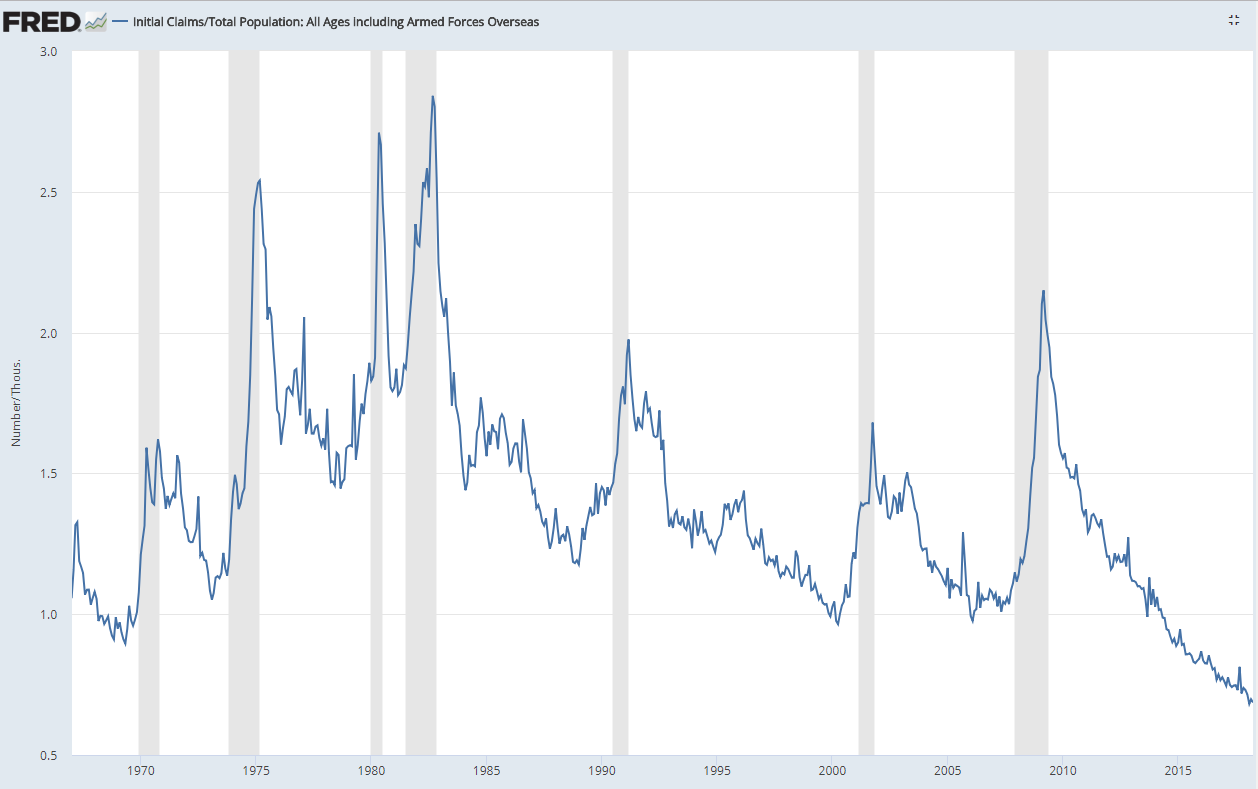
Initial Jobless Claims fell to 204,000, which is another 50 year record. When you take into account population growth, the number becomes even more dramatic:


Hurricane Florence has been downgraded to a Category 2 hurricane, but it is still expected to pack a wallop and dump a lot of rain. The hurricane is expected to dump 20-30 inches of rain over the area, which means flooding issues well inland. Servicers should expect to see an uptick in DQs going into the end of the year. Note that fewer households have flood insurance this time around. “Residents of these states are materially less prepared than they were in the past to deal with the financial consequences associated with major flooding events,” said Robert Hartwig, a risk-management and insurance professor at the University of South Carolina’s Darla Moore School of Business.

Ex-US Treasury Secretary Jack Lew is getting into the mortgage business, joining the advisory board of Blend, which is a consumer finance start-up that handles online mortgage applications for the GSEs and some of the larger banks. 

Doug Kass made the great observation about the business media and the 10th anniversary of the financial crisis, recalling Mickey Mantle's observation: "I didn't know how easy the game of baseball was until I entered the broadcasting booth."

HUD Secretary Ben Carson plans on doing more to remove zoning impediments to multifamily construction, though his approach will be different than the Obama Adminstration's. He plans on using Community Development Block Grant funds to encourage changes in zoning. The Obama admin sued localities directly, with the most prominent case being Westchester County in New York. Westchester County ended up being able to fend off HUD for the most part, which kind of shows the futility of that exercise. Westchester should have been a lay-up. Separately, the House is looking at regulatory costs and multifamily construction, which supposedly account for 30% of the cost of multi fam homebuilding according to NAHB. 

Wednesday, September 12, 2018

Morning Report: Wholesale inflation remains muted

Vital Statistics:


LastChange
S&P futures2888.5-0.25
Eurostoxx index376.661.28
Oil (WTI)70.210.93
10 year government bond yield2.97%
30 year fixed rate mortgage4.64%

Stocks are flat this morning as the East Coast braces for Hurricane Florence. Bonds and MBS are flat.

Mortgage Applications fell 1.8% during the Labor Day week as purchases increased 1% and refis fell 6%. The refi index is now at an 18 year low. We saw a 5 basis point increase in rates, which drove the drop in refis. As rates rise, cash-outs, fixed-for-ARM, and FHA for conventional are about the only game in town. 

Despite tariffs and increases in raw materials prices inflation at the wholesale level remains under control. The producer price index fell 0.1% last month but rose 2.8% on an annualized basis. Ex-food and energy, the number was down 0.1% MOM and up 2.3% YOY. So, despite the increase in wages we saw in the jobs report, inflation overall remains subdued. 

Yesterday's JOLTs report showed the quits rate (which is considered a leading indicator for wage inflation) hit the highest level since early 2001. Construction job openings increased to set another post-bubble high. Hurricane Florence will only exacerbate the labor shortage as workers get drawn into repair jobs. This probably means disappointing housing starts numbers for the rest of the year. 

Below is a chart which shows that average hourly earnings and the quits rate tend to correlate pretty closely.


Here are some things that homeowners in the path of Florence can do in order to prepare for impact. Note that the hurricane is expected to stall out once hit hits land, so you should expect some flooding inland. Servicers should prepare for an uptick in delinquencies. 

Redfin has a good retrospective on the top lasting impacts from the financial crisis. Probably the biggest surprise was that a leftist president presided over a huge jump in inequality. Given that Fed policy in the aftermath of the crisis was aimed at supporting asset prices, this shouldn't be a surprise. The other big surprise was the complete drop off in housing construction despite a tight housing market. 10 years down the road, it is still a head-scratcher. Everyone has a theory about the driver, from gun-shy builders, to labor shortages, to zoning restrictions. The places where the demand is greatest (CA and Seattle) have tight restrictions on building, and such an expensive market that businesses are relocating somewhere cheaper. On the other side of the coin, the Rust Belt is growing again, and that area has a surfeit of housing already built. 


Monday, September 10, 2018

Morning Report: Florence eyes the East Coast

Vital Statistics:


LastChange
S&P futures2884.259.55
Eurostoxx index375.792.02
Oil (WTI)68.050.29
10 year government bond yield2.93%
30 year fixed rate mortgage4.60%

Stocks are higher this morning on no real news. Bonds and MBS are up small. 

In terms of economic data, we will get CPI and PPI on Wed and Thursday and retail sales on Friday. There will be little in terms of Fed-speak. The Fed Funds futures continue to up the probability of a Dec hike (Sep is in the bag), which is now sitting at 79%. 

We are coming up on the 10 year anniversary of Lehman's collapse. Expect a lot of handwringing articles about whether we are set up for another collapse (we aren't). Residential real estate bubbles are rare events (the previous one was in the 1920s) and the psychological basis for bubbles to inflate requires decades and decades of bull markets to build up that sort of complacency. Not saying that we can't see pockets of decline, but a broad-based drop of 20% or more? Highly unlikely. 

Boston Fed President Eric Rosengren would like to see two more rate hikes in 2018 as the economy strengthens. He sees the economy expanding at a 3% pace for the rest of the year, and believes the Fed needs to keep going: “Going beyond just the next two hikes, I see no reason why we wouldn’t want to be at a more normalized rate, given the economic conditions we currently have, unless something changes dramatically that we’re not anticipating.” He also advocated that the Fed impose the counter-cyclical buffer, which requires banks to set aside additional capital in good times to draw upon when credit tightens. 

Hurricane Florence is looking more and more likely to hit the East Coast, with North and South Carolina as the center of the projected path. It is expected to reach the coast late Thursday night / early Friday morning. Lots of areas are already waterlogged so flooding will be an issue even inland. 

Canada sees reasons for optimism in NAFTA discussions and thinks we could see a deal. Any major changes will require legislation, but a tweak here and there will allow Trump to declare victory and move on. 

Interesting map of the average age of homes in the US. In the Northeast, the average age of an owner-occupied home is over 50 years. Most of these MSAs have been losing population over the past 10 years.